Potato
The BOLD Potato Project
The BOLD potato project aims to increase the potato diversity available to potato breeding programs and farmers by integrating lines derived from crop wild relatives (CWR) into breeding pipelines and developing new elite varieties with introgressions from CWR.


Why potato?

The potato is the third most important food crop in the world after rice and wheat in terms of human consumption. A single medium-sized potato contains about half the daily adult requirement of vitamin C. Other staples such as rice and wheat have none. The potato is very low in fat, with just 5% of the fat content of wheat, and one-fourth the calories of bread. Boiled, it has more protein than maize, and nearly twice the calcium. But it is not just a food crop, being used in the pharmaceutical, textile, wood and paper industries as an adhesive, binder, texture agent and filler and potato starch is a 100% biodegradable alternative to plastics used in manufacturing disposable plates and cutlery.
The crop is grown in more than 100 countries around the world, and are a staple food for more than 1 billion people. According to FAOStat, the five largest producers in 2024 were China, India, Ukraine, the Russian Federation and the United States of America.
The plants can be grown at any altitude and with little water, and a hectare of potato can yield two to four times the food quantity of a grain, making it an ideal mountain crop.
Potato: A Story of Generosity
This story is part of Crop Chronicles, a multimedia campaign that uncovers the stories of the crops that feed the world, the people who grow them and the race to adapt them to a changing climate.
Challenges
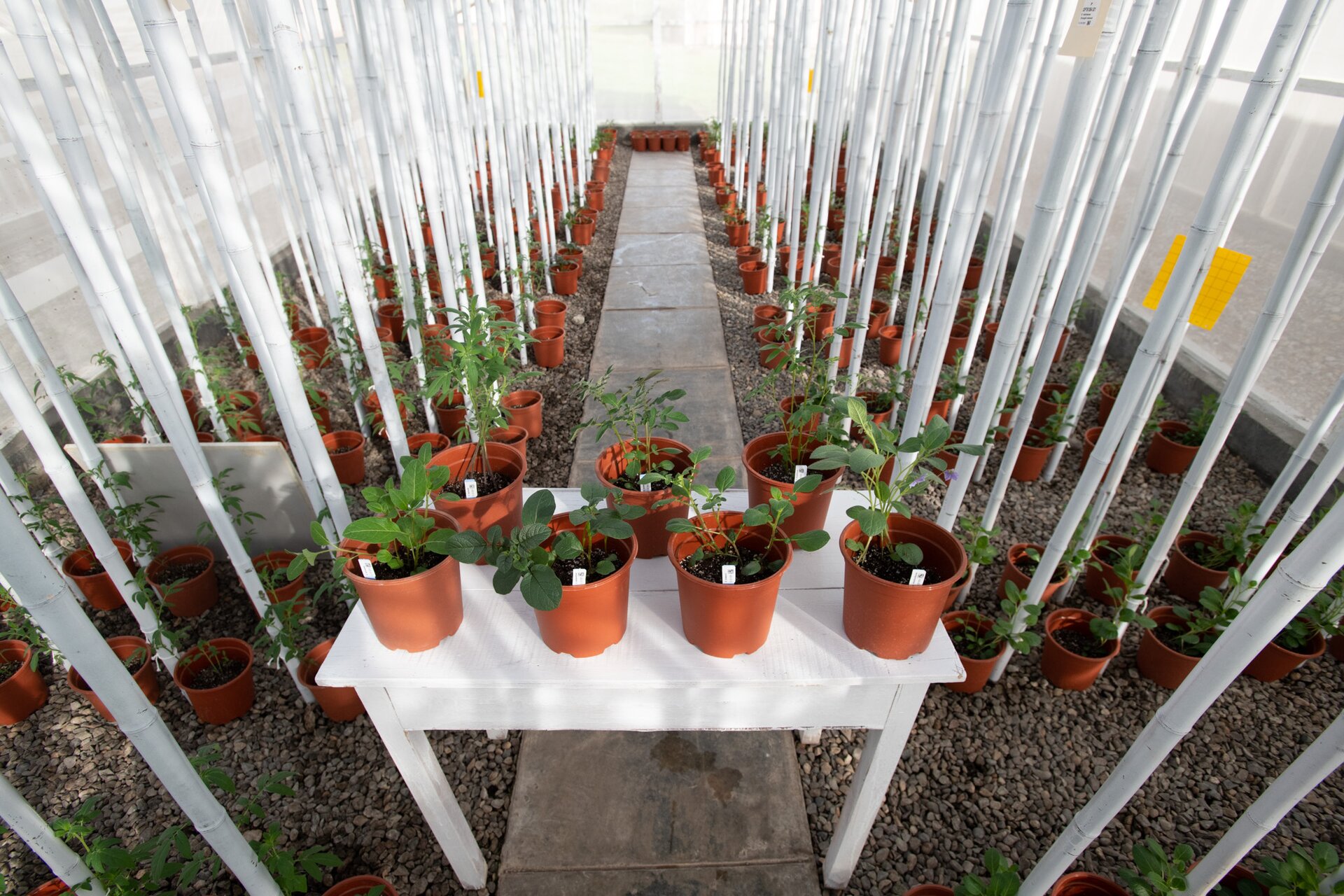
Potato faces a number of challenges, including the effects of climate change and a range of pests and diseases, particularly late blight and bacterial wilt. Previous work has identified sources of heat and drought tolerance and disease resistance in CWR. However, these are often weedy plants producing small, bitter tubers. Pre-breeding is needed to transfer these traits into the cultivated potato. A further challenge is that the crop is largely produced clonally rather than from true seed, which presents challenges for producing sufficient disease-free planting materials to promote large-scale uptake of new varieties.
Building on the Crop Wild Relatives Project
The Crop Wild Relatives Project made considerable strides in pre-breeding potatoes using CWR, culminating in the release of CIP-Matilde (2021) CIP-Asiryq (2025), new potato varieties derived from CWR that are almost completely resistant to late blight — a disease that caused an estimated global loss of $6.7 billion in yield losses and control costs and that is spreading into higher altitudes in the Andes. In Kenya, the project is introducing genetic traits from wild potato relatives originating in the Andes to develop climate-resilient and disease-resistant potato varieties for East African farmers.
Pre-bred lines developed from crosses with wild relatives have also shown good resistance to late blight and bacterial wilt and tolerance of heat, drought and salinity. The project also saw the development of testing of a new breeding approach — diploid hybridization — that facilitates pre-breeding and variety development between potato wild relatives and cultivated varieties.
Activities
- Introduce genetic traits from wild potato relatives originating in the Andes to fight late blight, a destructive plant disease, in the tropical highlands of East Africa.
- Breed potatoes resistance to late blight and virus better adapted to the tropical highlands
- Use participatory field trials where local growers evaluate and advance the promising materials aligned with the local and regional market demand
- Strengthen the potato breeding network for Africa with targeted genetic variability to respond faster to the involving markets and climate uncertainty
- Increase the local capacity on advanced breeding methods and tools - such as developing improved potato varieties through hybrid seed technology.
- Engaging local seed enterprises, particularly youth groups, connecting breeding to seed systems, increases the chances of adoption but also creates a feedback loop to the breeding process.
- A joint hybrid potato breeding program with a private-sector partner, leveraging diverse genetic resources and complementary expertise to accelerate genetic gain and increase the value to the money investment.
Partners
- International Potato Center, Kenya office (lead)
- Instituto Nacional de Investigaciones Agropecuarias, Ecuador
- Yanapai Group, Lima, Peru
- Kenya Agricultural and Livestock Research Organization (KALRO) – Tigoni, Kenya
- Agricultural Development Corporation - Molo Seed Potato Complex, Kenya.
Collaborators
- Ethiopian Institute of Agricultural Research (EIAR) – Ethiopia
- James Hutton Institute – Scotland
- HZPC Potatoes – The Netherlands
- Fresh Crop Kenya
- Youth Seed and service enterprises
- Potato Breeding Network for Africa
Potato resources
Crop Trust stories
- The Genetic Memory of the Potato: How Andean Diversity Shapes New Varieties for East African Farms
- How Wild Potato Genes Can Help East African Farmers Beat the ‘Chemical Tax’
- The Risk of One Potato: Shangi and the Challenge of Diversity in Kenya
- The Perfect Fry: Breeding Potato Varieties to Satisfy the Market
- New Potato Variety Offers a Lifeline to Farmers Battling Blight
- Crop Trust and CIP Announce New Disease-Proof Potato
- Perfecting the Potato, With Help From Peru’s Farmers
Relevant publications
- https://link.springer.com/article/10.1007/s00122-023-04515-7
- https://link.springer.com/article/10.1007/s12230-021-09839-y
- https://apsjournals.apsnet.org/doi/10.1094/PHYTO-06-24-0188-R
- https://acsess.onlinelibrary.wiley.com/doi/10.1002/csc2.21038
- https://scijournals.onlinelibrary.wiley.com/doi/full/10.1002/jsfa.12882